


ABSTRACT : In the wake of the 5th High-Level Ministerial Conference on antimicrobial resistance (AMR), the question is no longer whether the world recognises the threat – it is whether a decade of political consensus can finally translate into measurable reductions in morbidity, mortality and economic loss associated with AMR across the One Health spectrum. The 5th High-Level Ministerial Meeting on AMR in Abuja, Nigeria holding under the theme; “One Health – Advancing Global AMR Commitments through Local Action”, brings together ministers, policymakers, scientists, civil society leaders, and international partners to accelerate the global response to AMR. Moving from declarations to a collective path toward sustainable action against AMR.
Ranga Reddy Burri, MD, PGDPhM, AMP1* and James Ayukekbong, BMLS, MSc, PhD, CIC, LTC-CIP, AL-CIP2
1 Infection Control Academy of India (IFCAI), India
2 Dalla Lana School of Public Health, University of Toronto, Canada
*Corresponding author
Dr. Ranga Reddy Burri
President
Infection Control Academy of India (IFCAI)
India
email: dr.rangareddy@ifcai.in
Article history:
Received 4 April 2026
Received in revised form 10 April 2026
Accepted 24 April 2026
ABSTRACT
In the wake of the 5th High-Level Ministerial Conference on antimicrobial resistance (AMR), the question is no longer whether the world recognises the threat – it is whether a decade of political consensus can finally translate into measurable reductions in morbidity, mortality and economic loss associated with AMR across the
One Health spectrum.
The 5th High-Level Ministerial Meeting on AMR in Abuja, Nigeria holding under the theme; “One Health – Advancing Global AMR Commitments through Local Action”, brings together ministers, policymakers, scientists, civil society leaders, and international partners to accelerate the global response to AMR. Moving from declarations to a collective path toward sustainable action against AMR.
KEYWORDS:
Antimicrobial Resistance, One Health, Global Health
BACKGROUND
The global response to antimicrobial resistance (AMR) has matured politically, but not operationally. In the wake of the 5th High-Level Ministerial Conference on AMR in Abuja, Nigeria, the central question is no longer whether AMR constitutes a global threat. This debate was settled nearly a decade ago. The question now is whether the international community can translate accumulated commitments into measurable reductions in morbidity, mortality, and economic loss. The fight against AMR has followed a familiar trajectory in global health: recognition, mobilization, institutionalization, and increasingly stagnation at the level
of implementation.
A decade of political convergence
The past 10 years have witnessed an unusual degree of global alignment in the fight against AMR across human health, animal health, and environmental sectors. This convergence is reflected in successive ministerial conferences and United Nations declarations, each incrementally advancing the agenda. Importantly, this period has also seen the formalization of the One Health approach through the Quadripartite – bringing together the World Health Organization (WHO), the Food and Agriculture Organization (FAO), the World Organisation for Animal Health (WOAH), and the United Nations Environment Programme (UNEP) (Quadripartite Joint Secretariat on AMR, 2026). Yet, while alignment at the global level has been achieved, integration at the level of implementation remains partial and uneven.
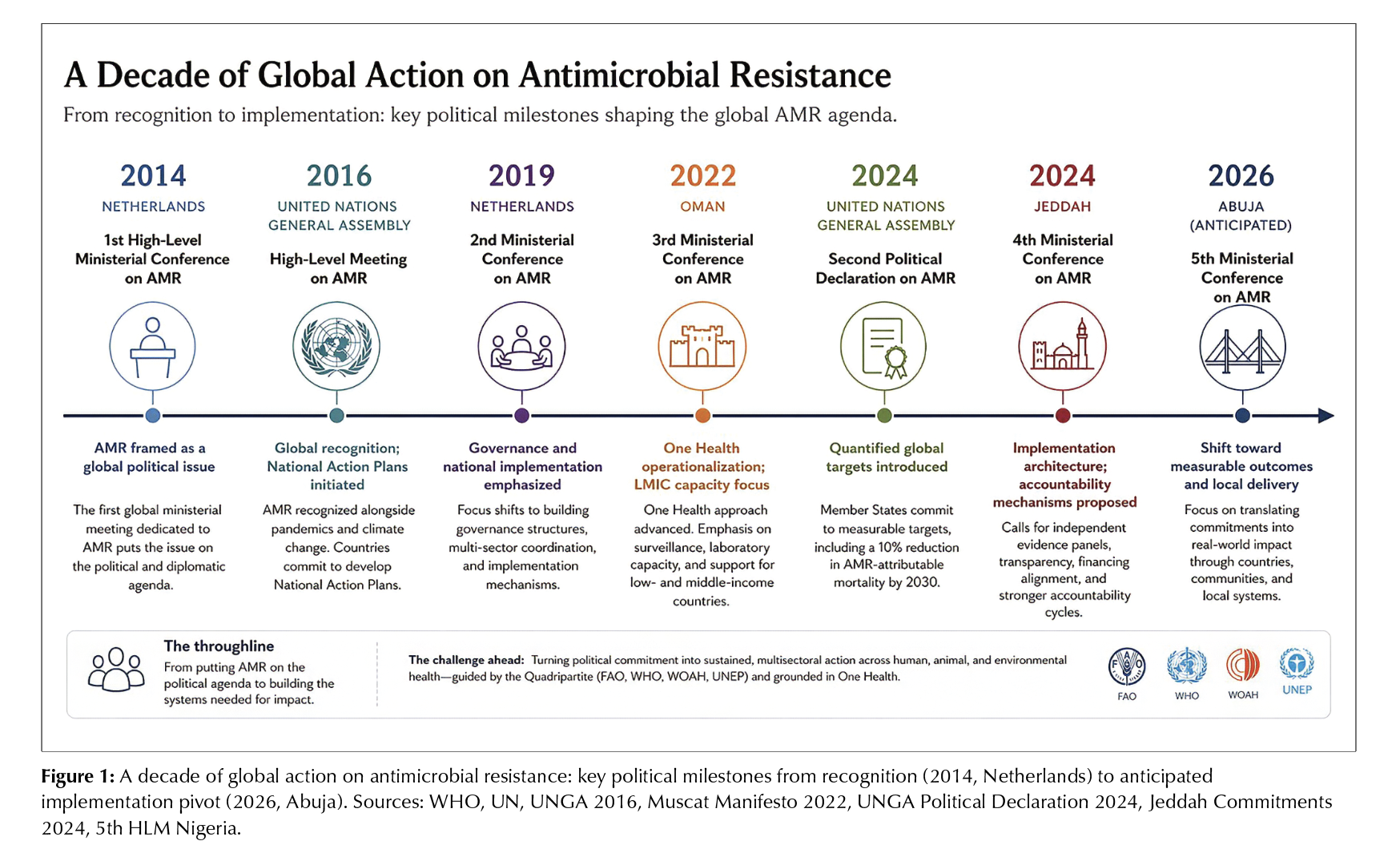
The 1st global high-level ministerial conference on AMR, held in The Hague in June 2014, placed AMR on the political and diplomatic agenda and catalysed the development of the WHO Global Action Plan on AMR, adopted by the World Health Assembly in 2015 (World Health Organization, 2015 and United Nations, Sep 2016). In September 2016, during the 71st session of the United Nations General Assembly, heads of state adopted the first political declaration on AMR (A/RES/71/3) – only the fourth health issue in United Nations history to be elevated to this level (United Nations, Oct 2016). The 2nd ministerial conference in Noordwijk (Netherlands, 2019) emphasized governance and national implementation, and led to the launch of the AMR Multi-Partner Trust Fund (UN Multi-Partner Trust Fund, 2019). Muscat, Oman (2022) introduced for the first time, numerical targets across human and animal sectors (Government of the Sultanate of Oman, 2022). The 2024 UNGA High-Level Meeting urged member states to commit to a measurable target of a 10% reduction in global AMR-attributable deaths by 2030 (United Nations, 2024). The Jeddah Commitments adopted weeks later translated that declaration into an implementation architecture, including the establishment of an Independent Panel for Evidence on Action against AMR (IPEA) (Kingdom of Saudi Arabia, 2024) (Figure 1).
From commitment to credibility
Despite this progression, implementation remains uneven.
As of late 2024, 178 countries had developed National Action Plans, but only 52% had functional coordinating mechanisms, and 68% were actively implementing their plans (Adepoju
et al., 2025).
The gap between policy and practice has become the defining feature of the AMR response. This gap is particularly pronounced in low- and middle-income countries (LMICs) where the burden of infectious diseases remains high and health systems face structural constraints. Here, AMR is not
a future threat but a current clinical reality (Ayukekbong
et al., 2017). Globally, bacterial AMR was directly responsible for an estimated 1.27 million deaths while AMR in general caused 5 million deaths in 2019 (Murray C et al., 2022). Without decisive action, projections indicate that AMR could cause over 39 million deaths between 2025 and 2050 (Naghavi et al., 2024).
The structural drivers of inaction
Three interrelated constraints continue to impede progress:
First – Financing remains fragmented
AMR lacks the sustained funding architecture seen in other global health priorities such as HIV or tuberculosis. Investments are episodic and often externally driven, limiting long-term system strengthening across both human and non-human sectors. The 2024 UNGA declaration called for US$100 million in catalytic funding and set a goal of 60% of countries having funded national action plans by 2030 (United Nations, 2024), ambitions that remain far from current reality.
Second – Surveillance systems are insufficiently integrated
Platforms exist for human health (WHO’s Global Antimicrobial Resistance and Use Surveillance System, GLASS), animal health (WOAH’s ANIMUSE database), agri-food systems (FAO’s International AMR Monitoring, InFARM), and the environment – but interoperability remains limited (Glass Report 2021). Without unified One Health surveillance, stewardship efforts operate with incomplete information, and key transmission pathways remain unaddressed.
Third – Institutional factors are underestimated
Infection prevention and antimicrobial stewardship depend not only on guidelines but on adherence, training, and organizational culture. At the same time, antimicrobial use in agriculture, informal access channels, and weak regulatory enforcement reflect broader systemic challenges beyond the healthcare setting.
Fourth – Policy advocacy and prescription framework remain weak and fragmented
Despite global declarations and national action plans, AMR suffers from low political salience, weak regulatory mechanisms, and insufficient coordination across sectors. This results in vague commitments that fail to translate into specific, enforceable policies or effective One Health governance.
If earlier milestones established intent, Abuja must establish
accountability – not only within health systems, but across the
full One Health spectrum.
Why the 5th high-level ministerial conference on antimicrobial resistance in Abuja matters
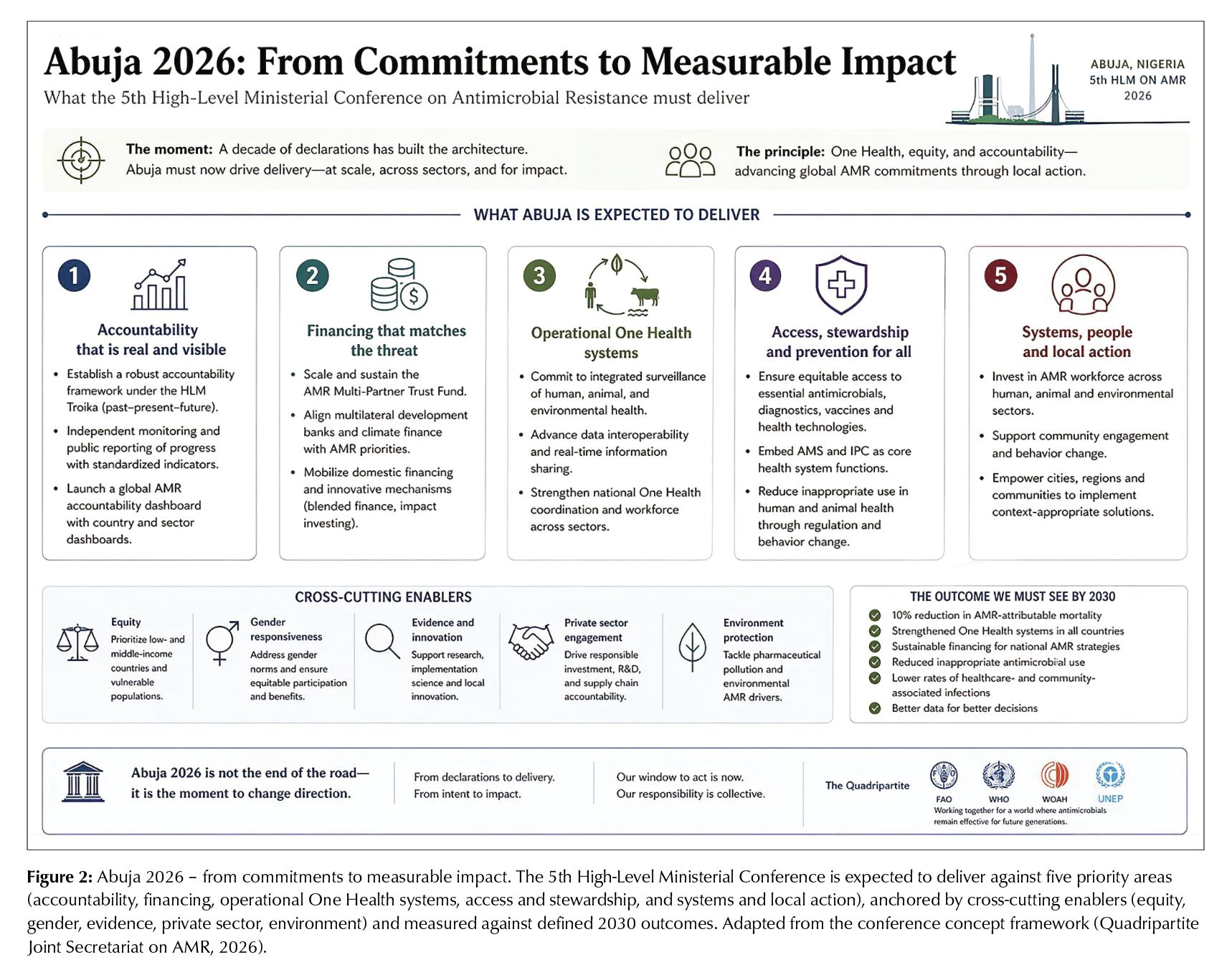
The 5th High-Level Ministerial Conference on AMR, to be held in Abuja from June 28–30, 2026 under the theme “One Health: Advancing Global AMR Commitments through Local Action”, represents a necessary pivot (Government of Nigeria, 2026). It is the first conference ever convened on the African continent, chaired by Nigeria under the Troika arrangement with past (Saudi Arabia) and future presidencies, a mechanism established at Jeddah to ensure continuity of commitments. Its significance lies less in its declarations rather in its potential to redefine expectations (Figure 2).
The moment is also strategically positioned. The conference falls midway between the 2024 UNGA High-Level Meeting and the 2029 review of the Political Declaration, and also coincides with the revision of the WHO Global Action Plan on AMR as well as the launch of the Independent Panel on Evidence for Action against AMR (IPEA) (Government of Nigeria, 2026). This requires a shift in emphasis in at least four areas.
Accountability mechanisms
Self-reported progress is insufficient. Independent monitoring frameworks, standardized indicators, and transparent reporting systems are needed to assess real-world implementation across sectors. The Troika mechanism combined with the forthcoming IPEA offers a structural opportunity if formalized in Abuja (World Organisation for Animal Health 2024).
Financing alignment
Multilateral development banks, national governments, and private sector actors must converge on sustainable financing models that include agriculture, environment, and health systems. The AMR Multi-Partner Trust Fund remains under-resourced relative to the scale of the challenge. Without alignment, implementation will remain aspirational (UN Multi-Partner Trust Fund, 2019).
Operational One Health systems
Integration across sectors must move beyond conceptual alignment to shared platforms, data interoperability, and coordinated governance involving all Quadripartite domains.
Workforce and system capacity
Investment in infection prevention, diagnostics, stewardship, and alternative therapies must be embedded within health systems – while parallel investments are made in veterinary services, food safety systems, and environmental regulation.
The role of the global south
A notable shift in the AMR discourse is the increasing centrality of the Global South – not only as a site of burden but as a source of innovation. That Nigeria – where AMR was directly attributable to an estimated 64,500 deaths in 2021 and has shaved approximately 7% off GDP and 11% off livestock productivity – is hosting this conference is not incidental. It is a deliberate repositioning of African leadership at the centre of global AMR governance (Adepoju et al., 2025).
Resource-constrained settings have demonstrated the ability to develop cost-effective, scalable interventions, particularly in infection prevention and community-based care. However, similar innovation is needed in sustainable livestock practices, environmental risk mitigation, and integrated surveillance models. Abuja offers an opportunity to recalibrate this imbalance by positioning LMICs as leaders in contextualised One Health implementation, rather than recipients of externally designed approaches.
As suggested by Adepoju et al., the Abuja meetings should launch an annual AMR scorecard with a list of metrics reported by all countries: access to antibiotics for both animal and human use, consumption in defined daily doses, prescription-only enforcement in retail sales, regulatory frameworks, surveillance system and AMR tracking, etc. Each metric should have targets with financing commitments tied to progress and independent verification.
Reframing the antimicrobial resistance challenge
The prevailing narrative of AMR as a medical or pharmaceutical problem is incomplete. While drug development remains important, the more immediate determinants of AMR lie in health system performance, agricultural practices, regulatory oversight, and
human behaviour.
Hospitals with robust infection prevention programs consistently report lower rates of healthcare-associated infections and reduced antimicrobial use. However, these gains risk being offset if resistance continues to be generated and disseminated through other pathways. AMR, therefore, is best understood not solely as a microbiological phenomenon, but as a multi-sectoral systems failure spanning human, animal, and environmental domains.
Road to better antimicrobial resistance containment
The global community has invested over a decade in defining the AMR problem and aligning around solutions. What remains is to demonstrate impact.
The 5th High-Level Ministerial Conference on AMR in Abuja will test whether the transition from commitment to implementation can be realised – not only within healthcare systems, but across the broader One Health landscape. If it succeeds, it may mark the beginning of a phase characterized by measurable progress. If it does not, AMR risks becoming another example of well-articulated global consensus without corresponding outcomes.
The stakes are not abstract, they are measured in infections that could have been prevented, treatments that no longer work, and lives that otherwise might have been saved.
CONCLUSION
The next phase of the AMR response will not be judged by
the strength of its declarations, but by the evidence of its delivery – across all sectors where resistance is created, amplified, and transmitted.
REFERENCES
Adepoju, V. A., Abdulrahim, A., & Gulumbe, B. H. (2025).
From declarations to accountability: Nigeria 2026 and the global fight against antimicrobial resistance. Antimicrobial Resistance & Infection Control, 14, 138.
Ayukekbong, J. A., Ntemgwa, M., & Atabe, A. N. (2017).
The threat of antimicrobial resistance in developing countries: Causes and control strategies. Antimicrobial Resistance & Infection Control, 6, 47.
https://doi.org/10.1186/s13756-017-0208-x
Federal Government of Nigeria. (2026, June 28–30).
5th high-level ministerial conference on
antimicrobial resistance.
https://www.5thhighlevelministerialng.com/
Global Antimicrobial Resistance and Use Surveillance
System (GLASS). (2021). GLASS report 2021.
World Health Organization.
https://www.who.int/initiatives/glass
Government of the Sultanate of Oman & Quadripartite organisations. (2022, November 24–25).
Muscat ministerial manifesto on antimicrobial resistance. https://amrconference2022.om/MuscatManifesto.html
Kingdom of Saudi Arabia & Quadripartite organisations.
(2024, November 15–16). The Jeddah commitments. https://amrconference2024.com/
Murray, C. J. L., Ikuta, K. S., Sharara, F., et al. (2022). Global burden of bacterial antimicrobial resistance in 2019: A systematic analysis. The Lancet, 399, 629–655.
Naghavi, M., Vollset, S. E., Ikuta, K. S., et al. (2024). Global burden of bacterial antimicrobial resistance 1990–2021:
A systematic analysis with forecasts to 2050.
The Lancet, 404, 1199–1226.
Quadripartite Joint Secretariat on AMR. (n.d.).
https://www.qjsamr.org/
United Nations. (2016, September 21). High-level meeting on antimicrobial resistance. Office of the President of the
71st UN General Assembly.
https://www.un.org/pga/71/event-latest/high-level-meeting-on-antimicrobial-resistance/
United Nations General Assembly. (2016, October 5). Political declaration of the high-level meeting of the General Assembly on antimicrobial resistance (A/RES/71/3).
https://digitallibrary.un.org/record/842813
United Nations General Assembly. (2024, September 26). Political declaration of the high-level meeting on antimicrobial resistance (A/RES/79/5).
https://digitallibrary.un.org/record/4064122?ln=en
United Nations Multi-Partner Trust Fund Office. (2019). Antimicrobial resistance multi-partner trust fund
(AMR MPTF). https://mptf.undp.org/fund/amr00
World Health Organization. (2015). Global action plan on antimicrobial resistance.
https://www.who.int/publications/i/item/9789241509763
World Organisation for Animal Health. (2024, November 21). Global ministers and partners pledge action with new Jeddah commitments on AMR: Troika process and independent panel for evidence on action.
https://www.woah.org/en/global-ministers-and-partners-pledge-action-with-new-jeddah-commitments-on-amr/