


ABSTRACT
Background: Device-associated infections remain a major patient safety concern in intensive care units (ICUs), particularly in cardiovascular surgery settings where invasive device utilization is high.
Firdevs Ebru Özdemir, PhD, RN1*
*Corresponding author Firdevs Ebru Özdemir, PhD, RN Cardiovascular Surgery Intensive Care Unit Mersin University Hospital Mersin, Türkiye Phone: +905058542080
email: ebruozdemir@mersin.edu.tr
Article history: Received 16 February2026 Received in revised form 21 April 2026 Accepted 19 May 2026
ABSTRACT
Background: Device-associated infections remain a major patient safety concern in intensive care units (ICUs), particularly in cardiovascular surgery settings where invasive device utilization is high.
Methods: This retrospective surveillance study analyzed routinely collected infection prevention data from January 2023 to December 2025 in a cardiovascular surgery ICU. Infection rates were calculated per 1,000 device-days, and device utilization ratios were determined. Results: During the three-year study period, 3,387 patient-days were recorded, including 1,167 ventilator-days, 3,251 urinary catheter-days, and 2,664 central line-days. Device utilization ratios were 0.34 for ventilators, 0.96 for urinary catheters, and 0.79 for central lines. One ventilator-associated pneumonia (0.86 per 1,000 ventilator-days) and one central line-associated bloodstream infection (0.38 per 1,000 central line-days) were identified. No catheter-associated urinary tract infections were observed. Conclusions: Long-term surveillance data provide important context for device utilization and device-associated infection trends in specialized surgical ICUs. Sustained infection prevention and control measures may improve outcomes despite increased device utilization.
KEYWORDS:
Device-associated infection; device utilization; intensive care unit; infection prevention; surveillance; patient safety
INTRODUCTION
Device-associated healthcare-associated infections (DA-HAIs) remain a major cause of morbidity and mortality in intensive care units (ICUs) worldwide (Magill et al., 2018). Ventilator-associated pneumonia (VAP), catheter-associated urinary tract infection (CAUTI), and central line-associated bloodstream infection (CLABSI) are among the most common ICU-acquired infections and are associated with increased length of stay, antimicrobial exposure, healthcare costs, and mortality (Klompas et al., 2022). Despite improvements in infection prevention strategies, surveillance data continue to demonstrate a substantial infection burden among critically ill patients (Vincent et al., 2020). Cardiovascular surgery ICUs represent a high-risk setting for DA-HAIs because of the frequent use of invasive devices such as mechanical ventilation, urinary catheters, and central venous catheters. Postoperative hemodynamic instability and the complexity of cardiothoracic procedures often necessitate prolonged device use, which may further increase infection risk.Implementation of evidence-based infection prevention bundles has been associated with reductions in device-associated infection rates (Pronovost et al., 2010; Saint et al., 2016). However, most published reports describe short-term outcomes following targeted quality improvement initiatives, and fewer studies have examined long-term surveillance data from specialized surgical ICUs. Data describing sustained infection rates in settings with persistently high device utilization remain limited. The aim of this study was to describe device utilization patterns and device-associated infection rates over a three-year period in a cardiovascular surgery ICU using routinely collected surveillance data.
METHODS
Study design and setting This retrospective surveillance study was conducted in a seven-bed cardiovascular surgery intensive care unit (ICU) at a tertiary university hospital in Turkey. The unit provides postoperative care to adult patients undergoing open-heart surgery, aortic procedures, and complex thoracic interventions and is characterized by sustained high utilization of invasive devices.
Study population and period
All adult patients (≥18 years) admitted to the cardiovascular surgery ICU between January 2023 and December 2025 were included. For infection rate calculations, patients with an ICU length of stay of less than 24 hours were excluded from device-day calculations but were included in overall patient-day counts.
Data sources and surveillance procedures
De-identified data were retrospectively extracted from the institutional infection prevention surveillance system. Collected variables included patient-days, ventilator-days, urinary catheter-days, central line-days, and documented device-associated infection events, including ventilator-associated pneumonia (VAP), catheter-associated urinary tract infection (CAUTI), and central line-associated bloodstream infection (CLABSI).
The surveillance system routinely collects, validates, and reports device utilization and healthcare-associated infection data as part of institutional infection monitoring practices.
Definitions and outcome measures
Device-associated infections were defined according to the Centers for Disease Control and Prevention/National Healthcare Safety Network (CDC/NHSN) surveillance criteria, consistent with national surveillance standards (Centers for Disease Control and Prevention, 2024). Infection rates were calculated as the number of events per 1,000 device-days. Device utilization ratios were calculated as device-days divided by patient-days.
Infection prevention practices
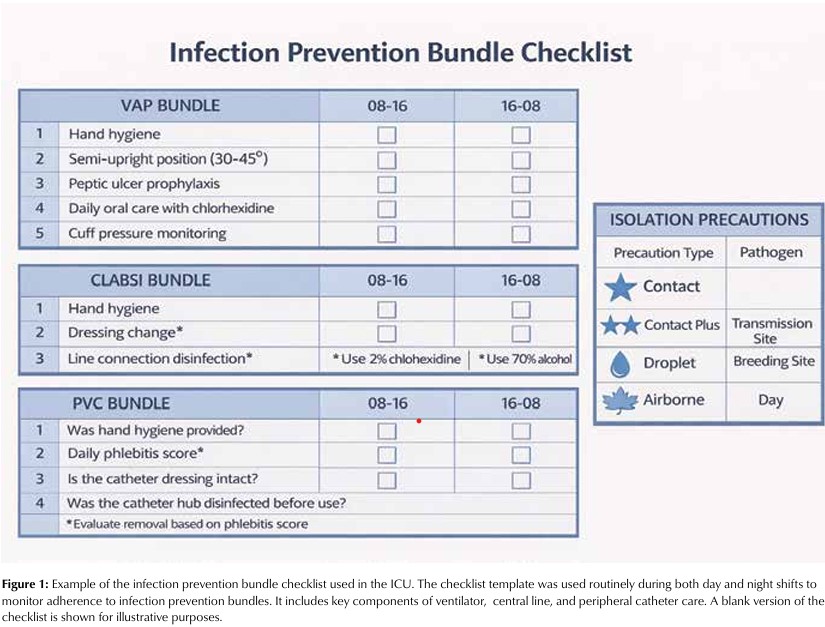
Standardized infection prevention bundles consistent with CDC recommendations were maintained throughout the study period. These included aseptic device insertion, maintenance of closed systems, standardized site care, head-of-bed elevation for ventilated patients, and daily assessment of device necessity. No changes to bundle components were introduced during the surveillance period.
Ethical considerations
This study was based on routinely collected, retrospective, and fully de-identified surveillance data. In accordance with institutional policy and national regulations, formal ethical approval and informed consent were not required.
RESULTS
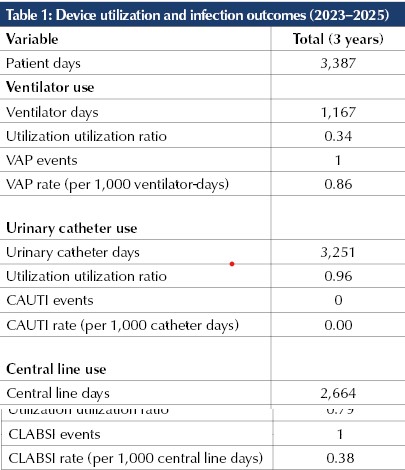
Patient-days and device utilization Between January 2023 and December 2025, a total of 3,387 patient-days were recorded in the cardiovascular surgery intensive care unit. A total of 1,167 ventilator-days, 3,251 urinary catheter-days, and 2,664 central line-days were documented. The overall device utilization ratios (device-days/patient-days) were as follows: ventilator utilization ratio, 0.34; urinary catheter utilization ratio, 0.96; and central line utilization ratio, 0.79
(Table 1).
Device-associated infecton outcomes
During the three-year surveillance period, two device-associated infection events were identified. One ventilator-associated pneumonia (VAP) occurred in 2023, corresponding to a rate of 0.86 per 1,000 ventilator-days. One central line-associated bloodstream infection (CLABSI) occurred in 2025, corresponding to a rate of 0.38 per 1,000 central line-days. No catheter-associated urinary tract infections (CAUTIs) were recorded during the study period (0.00 per 1,000 catheter-days). Overall, device-associated infection occurrence remained low despite sustained exposure to invasive devices in a high-acuity cardiovascular surgery population.
DISCUSSION
This three-year surveillance study demonstrated low device-associated infection rates in a cardiovascular surgery intensive care unit despite sustained high device utilization. The overall VAP rate of 0.86 per 1,000 ventilator-days and CLABSI rate of 0.38 per 1,000 central line-days were lower than pooled means commonly reported in international intensive care unit surveillance studies (Klompas et al., 2022; Centers for Disease Control and Prevention, 2024). Notably, no CAUTI events were observed during the study period.
Cardiovascular surgery intensive care units are characterized by prolonged exposure to invasive devices, which increases the risk of healthcare-associated infections. In this context, the observed infection rates suggest stable infection prevention performance over time. Although only two infection events occurred during the surveillance period, infection rates were calculated using standardized CDC/NHSN definitions, ensuring comparability with national and international benchmarks (Centers for Disease Control and Prevention, 2024).
The use of standardized surveillance definitions strengthens the validity of rate-based comparisons and supports consistent infection monitoring practices across high-acuity clinical settings.
Previous large-scale surveillance initiatives and quality improvement programs have demonstrated that implementation of evidence-based prevention bundles can substantially reduce device-associated infection rates in intensive care units (Pronovost et al., 2010; Saint et al., 2016). However, many published reports focus primarily on short-term outcomes following targeted interventions. Long-term unit-level surveillance data from specialized surgical intensive care units remain limited.
The present study contributes longitudinal, rate-based evidence from a cardiovascular surgery population with sustained device exposure and routine infection prevention practices. The absence of CAUTI events and the low CLABSI and VAP rates observed in this study are consistent with evidence indicating that strict adherence to aseptic insertion techniques, standardized device maintenance, ventilator care practices, and daily assessment of device necessity are central components of infection prevention (Blot et al., 2014; Fakih et al., 2016;
Krein et al., 2012). Prevention of micro aspiration and maintenance of effective airway management, particularly in mechanically ventilated patients, have been identified as key elements in reducing the risk of VAP (Blot et al., 2014). In addition, adequate staffing levels and stable clinical teams have been associated with lower healthcare-associated infection risk in critical care environments (Mitchell et al., 2018). These findings support the importance of consistent nursing practice and routine surveillance as fundamental components of infection
prevention strategies.
From a clinical perspective, continuous surveillance of device utilization and infection outcomes provides valuable feedback for monitoring practice performance and maintaining patient safety standards in specialized surgical intensive care settings. Routine surveillance systems may also facilitate early detection of deviations in clinical practice and support ongoing quality assurance efforts in high-risk patient populations.
This study has several limitations. The small number of infection events precluded formal statistical modelling or risk factor analysis. A key limitation is the lack of correlation between specific infection prevention and control interventions and outcomes. Additionally, the single-centre design may limit generalizability. Nevertheless, the extended surveillance period, complete capture of patient-days and device-days, and use of standardized CDC/NHSN criteria strengthen the reliability of the reported infection rates.
CONCLUSION
Low device-associated infection rates were observed over a three-year period in a cardiovascular surgery ICU with sustained high device utilization. Long-term surveillance using standardized definitions provides important context for understanding infection trends in these specialized surgical settings. Ongoing adherence to infection prevention practices and structured surveillance systems may contribute to maintaining low device-associated infection rates in high-risk populations. These findings support the importance of routine infection surveillance and consistent nursing practice in high-acuity cardiovascular surgery intensive care settings.
REFERENCES
Blot, S., Poelaert, J., & Kollef, M. (2014). How to avoid microaspiration? A key element for the prevention of ventilator-associated pneumonia in intubated ICU patients. BMC Infectious Diseases, 14, Article 119.https://doi.org/10.1186/1471-2334-14-119
Centers for Disease Control and Prevention. (2024). National Healthcare Safety Network (NHSN) patient safety component manual. https://www.cdc.gov/nhsn/
Fakih, M. G., Gould, C. V., Trautner, B. W., et al. (2016). Beyond infection: Device utilization ratio as a performance measure for urinary catheter harm. Infection Control & Hospital
Epidemiology, 37(3), 327–333. https://doi.org/10.1017/ice.2015.287
Klompas, M., Li, L., Szumita, P. M., Kleinman, K., & Murphy, M. V. (2022). Associations between ventilator bundle compliance and outcomes. American Journal of Infection Control, 50(4), 451–457. https://doi.org/10.1016/j.ajic.2021.09.010
Krein, S. L., Kowalski, C. P., Hofer, T. P., & Saint, S. (2012). Preventing hospital-acquired infections: A national survey of practices reported by U.S. hospitals. Journal of General Internal Medicine, 27(7), 773–779. https://doi.org/10.1007/s11606-011-1935-y
Magill, S. S., O’Leary, E., Janelle, S. J., Thompson, D. L., Dumyati, G., Nadle, J., et al. (2018). Changes in prevalence of health care–associated infections in U.S. hospitals. New England Journal of Medicine, 379(18), 1732–1744. https://doi.org/10.1056/NEJMoa1801550
Mitchell, B. G., Gardner, A., Stone, P. W., Hall, L., & Pogorzelska-Maziarz, M. (2018). Hospital staffing and health care–associated infections: A systematic review. American
Journal of Infection Control, 46(1), 133–142. https://doi.org/10.1016/j.ajic.2017.09.012
Pronovost, P. J., Goeschel, C. A., Colantuoni, E., Watson, S., Lubomski, L. H., Berenholtz, S. M., et al. (2010). Sustaining reductions in catheter-related bloodstream infections in Michigan intensive care units. BMJ, 340, c309. https://doi.org/10.1136/bmj.c309
Saint, S., Greene, M. T., Krein, S. L., Rogers, M. A. M., Ratz, D., Fowler, K. E., et al. (2016). A program to prevent catheter-associated urinary tract infection in acute care. New England Journal of Medicine, 374(22), 2111–2121. https://doi.org/10.1056/NEJMoa1504906
Vincent, J. L., Sakr, Y., Singer, M., Martin-Loeches, I., Machado, F. R., Marshall, J. C., et al. (2020). Prevalence and outcomes of infection among patients in intensive care units in 2017. JAMA, 323(15), 1478–1487. https://doi.org/10.1001/jama.2020.2717