


ABSTRACT
Background: Tetracyclines are widely used antibiotics and are receiving increasing attention for the post-exposure prophylaxis of sexually transmitted infections (STIs). Surveillance is needed to monitor community resistance to these agents.
Hyunseo (Emma) Jin1 and Eugene Y. H. Yeung, MD, MSc, BSc(Pharm), FRCPC, FCCM, D(ABMM), DTM&H, CTH, CIC, LTC-CIP1,2,3*
1 Faculty of Pharmaceutical Sciences, University of British Columbia, Vancouver, BC, Canada
2 Faculty of Medicine, University of British Columbia, Vancouver, BC, Canada
3 School of Medicine, Simon Fraser University, Surrey, BC, Canada
*Corresponding author
Eugene Y.H. YeungLifeLabs, 7455 130 St.Surrey, BC, V3W 1H8 Canadaemail: eugeney@doctors.org.uk
Article history:
Received 16 January 2026
Received in revised form 2 April 2026
Accepted 20 April 2026
ABSTRACT
Background: Tetracyclines are widely used antibiotics and are receiving increasing attention for the post-exposure prophylaxis of sexually transmitted infections (STIs). Surveillance is needed to monitor community resistance to these agents.
Methods: This surveillance study analyzed resistance data for the 15 most common bacterial isolates from all clinical specimens that underwent tetracycline, doxycycline, or minocycline susceptibility testing at LifeLabs British Columbia between 2020 and 2024. Antimicrobial susceptibility testing followed Clinical and Laboratory Standards Institute guidance. The study analyzed 563 doxycycline, 791 minocycline, and 266,721 tetracycline susceptibility test results.
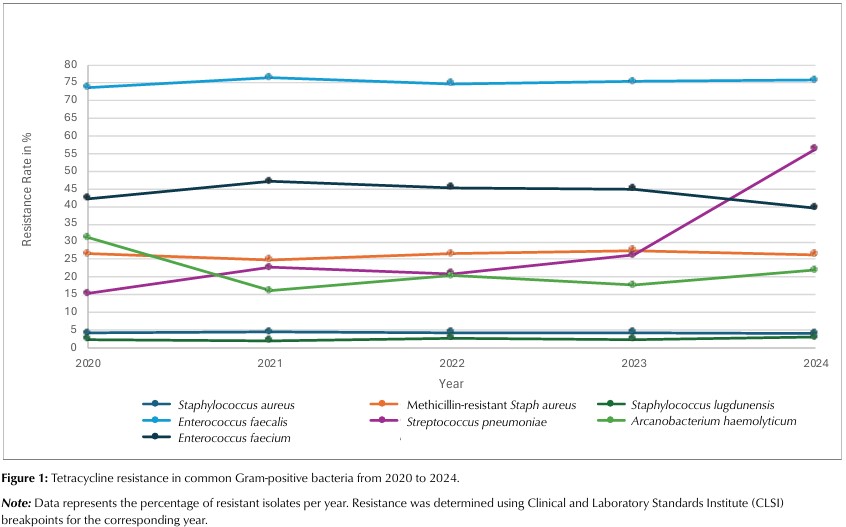
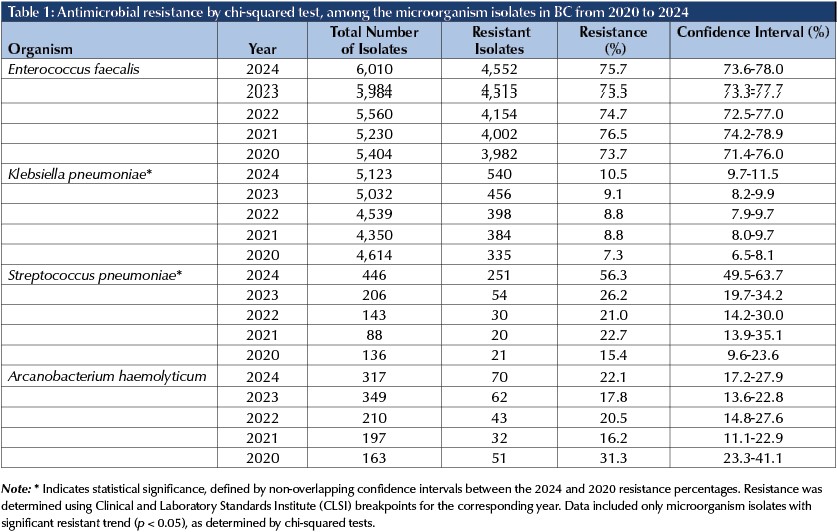
Results: A significant increase (p < 0.05) in tetracycline resistance was observed in Streptococcus pneumoniae [15.4% (n = 136) to 56.3% (n = 446)], Klebsiella pneumoniae [7.3% (n = 4,614) to 10.5% (n = 5,123)], and Enterococcus faecalis [73.7% (n = 5,404) to 75.7% (n = 6,010)]. No significant changes were observed in doxycycline resistance among methicillin-susceptible Staphylococcus aureus [0% (n = 39) to 3.0% (n = 67)], doxycycline resistance among methicillin-resistant Staphylococcus aureus [4.8% (n = 21) to 10.3% (n = 39)], or minocycline resistance in Stenotrophomonas maltophilia [0.9% (n = 106) to 0.8% (n = 125)].
Conclusion: The observed increase in resistance highlights the need for ongoing surveillance and judicious prescribing of tetracyclines, particularly as their use expands to indications such as post-exposure prophylaxis for STIs.
KEYWORDS:
Tetracycline resistance; Streptococcus pneumoniae; Klebsiella pneumoniae
INTRODUCTION
Tetracyclines, including tetracycline, doxycycline, and minocycline are antimicrobial agents used to treat a variety of infections, including pneumonia and other respiratory tract infections, urinary tract infections, skin and soft tissue infections, and gastrointestinal infections. They also have unique clinical indications, including the treatment of rosacea, acne, and Lyme disease (Lantos et al., 2021; Shutter & Akhondi, 2023). In Canada, tetracyclines are also used prophylactically to prevent malaria and Lyme disease (Boggild et al., 2016; Holmes & Charles, 2009; Shutter & Akhondi, 2023).
Among the tetracyclines, doxycycline remains the preferred option because of its high oral bioavailability, cost-effectiveness, and favourable safety profile (Leung et al., 2025). More recently, tetracyclines have also been investigated as post-exposure prophylaxis for sexually transmitted infections (STIs) (Lantos et al., 2021). However, concerns about antimicrobial resistance, particularly with repeated or prolonged use have led clinicians to adopt a more cautious approach to their widespread use (Lantos et al., 2021).
Despite the need for resistance surveillance, community-level data remain limited. Collecting such data is challenging because many community health care institutions outsource microbiology services and rely on multiple diagnostic laboratories, limiting access to consolidated, community-specific information (Clinical & Laboratory Standards Institute, 2022). To address this gap, the present study analyzed tetracycline resistance among common bacterial isolates processed at LifeLabs British Columbia (BC) regional microbiology laboratories between 2020 and 2024. The aim of this study was to characterize community resistance patterns to support evidence-based clinical decision-making and antimicrobial stewardship efforts in the region.
METHODS
Data collection and analysis
A retrospective audit was conducted using the Microbiology Electronic Worksheet System (MEWS; Version 5.00.267; LifeLabs, Toronto, ON, Canada), which served as the data source for all recorded tetracycline susceptibility results between January 1, 2020, and December 31, 2024. The dataset included results from LifeLabs’ regional microbiology laboratories in BC (Surrey, Victoria, and Kamloops), which received specimens from 129 affiliated community collection centres. All clinical specimens originated from community and outpatient health care services and did not include hospital inpatient services. The study included clinical specimens from all anatomical sites that underwent antimicrobial susceptibility testing at LifeLabs BC. A total of 563 doxycycline, 791 minocycline, and 266,721 tetracycline susceptibility test results were analyzed, representing 30.9% male patients and 7.6% paediatric patients (aged <18 years). The most common specimen type was urine (76.0%), followed by wound (19.5%), respiratory (0.4%), and stool (0.3%). Patient identifiers were anonymized before analysis.
Identification of microorganisms in culture
Specimen processing was performed according to the test requests indicated by clinicians on requisition forms and in accordance with LifeLabs BC standard operating procedures. Specimens were collected at patient service centres or directly by the ordering clinicians and transported to one of the LifeLabs BC regional microbiology laboratories in Surrey, Victoria, or Kamloops. Upon receipt, microbiology staff inoculated the specimens onto agar plates and incubated them for at least 18 hours. After incubation, cultures demonstrating significant microbial growth underwent further identification according to LifeLabs BC protocols. Species-level identification was performed using the VITEK2 System (bioMérieux Inc., Durham, NC, USA) and matrix-assisted laser desorption/ionization time-of-flight mass spectrometry (MALDI-TOF MS; Bruker Daltonics GmbH & Co. KG, Bremen, Germany) in accordance with the manufacturers’ instructions. All identification results were recorded in the MEWS laboratory information system.
Antimicrobial susceptibility testing
Tetracycline susceptibility testing was performed using the VITEK2 automated antimicrobial susceptibility testing (AST) system in accordance with the manufacturer’s instructions. The procedures had previously been validated using methods approved by the Clinical and Laboratory Standards Institute (CLSI) (Clinical & Laboratory Standards Institute, 2024). Minimum inhibitory concentration (MIC) values were interpreted using the clinical breakpoints outlined in the CLSI M100 Performance Standards for the applicable year. These breakpoints were used to classify microorganisms as susceptible, intermediate, or resistant to tetracycline (Clinical & Laboratory Standards Institute, 2024).
When the VITEK2 system did not yield results because of verification failures or insufficient microbial growth, AST was performed using the Kirby–Bauer disk diffusion method. If this method also failed to produce results, Etest gradient diffusion testing was performed. When none of these methods yielded interpretable results, a microbiologist reviewed the case and discontinued testing as appropriate.
Doxycycline and minocycline were not included in the VITEK2 test cards. Consequently, susceptibility testing for these agents was initially performed using the Kirby-Bauer disk diffusion method. If this method was unsuccessful, Etest gradient diffusion testing was performed. If neither method yielded interpretable results, a microbiologist determined whether testing should be discontinued. Final AST results were recorded in the MEWS laboratory information system.
It is important to note that the CLSI breakpoints for Stenotrophomonas maltophilia susceptibility to minocycline were revised in 2024 (Clinical & Laboratory Standards Institute, 2024). Therefore, temporal trends involving minocycline susceptibility for this organism should be interpreted with caution because breakpoint changes may have affected trend analyses and comparisons across years.
Statistical analysis
Statistical analyses were performed using chi-squared tests, with and without Yates’ continuity correction, using the Quantpsy.org statistical tool (https://www.quantpsy.org/chisq/chisq.htm). A p-value of <0.05 was considered statistically significant. Separate chi-squared tests were conducted for each organism–antibiotic combination (doxycycline, minocycline, and tetracycline), with year used as the grouping variable. For these analyses, isolates were classified as resistant or non-resistant according to the CLSI M100 breakpoints applicable to each study year (Clinical & Laboratory Standards Institute, 2024).
For results with p < 0.05, 95% confidence intervals (95% CIs) were calculated using the MedCalc online calculator (https://www.medcalc.org/calc/rate_ci.php) to further assess the consistency of the observed differences. When the 95% CIs of the compared groups overlapped, the findings were considered inconclusive because the statistical significance was not consistently supported by the confidence interval estimates. This additional analysis helped determine whether statistically significant differences were also likely to be clinically meaningful. Data for the remaining 95% CI comparisons are available upon request (data not shown).
Sample size justification was based on the CLSI M39 guidelines, which recommend a minimum of 30 isolates per group for valid statistical interpretation (Clinical & Laboratory Standards Institute, 2022). The doxycycline analysis for methicillin-resistant Staphylococcus aureus (MRSA) included fewer than 30 isolates because doxycycline susceptibility testing was performed only upon specific request and was not part of routine testing. In accordance with the CLSI M39 guidelines, these findings should be interpreted with caution because of the potential for selection bias (Clinical & Laboratory Standards Institute, 2022). Because a large number of organisms underwent tetracycline susceptibility testing, the present study focused on the 15 most frequently tested bacterial species. Consistent with the CLSI M39 guidelines, only the first isolate from any anatomical site for each patient during the study period (2020–2024) was included; repeat isolates from the same patient were excluded from the analysis.
RESULTS
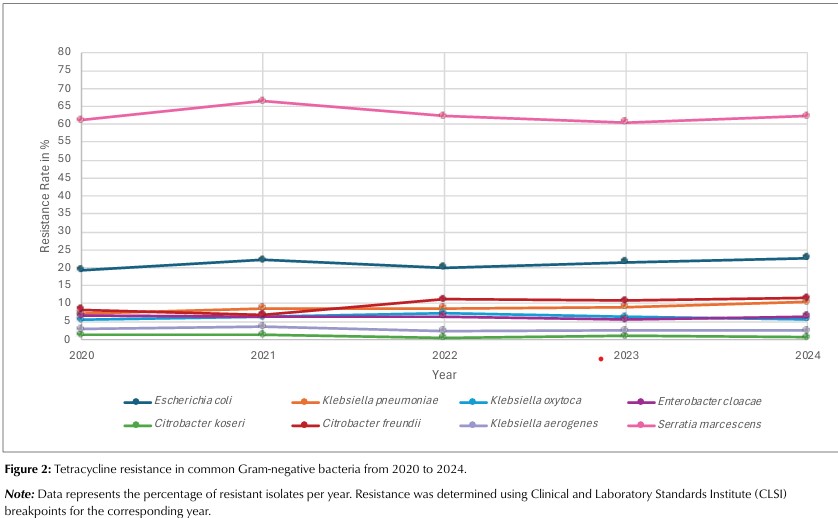
For tetracycline resistance, only Klebsiella pneumoniae and Streptococcus pneumoniae demonstrated statistically significant differences based on both the chi-squared tests and the 95% confidence intervals (95% CIs), as shown in Table 1. S. pneumoniae exhibited a marked increase in resistance, rising from 26.2% in 2023 to 56.3% in 2024 (Figure 1). Compared with the baseline resistance of 15.4% in 2020, this represented a substantial upward trend. Although Enterococcus faecalis and Arcanobacterium haemolyticum yielded p-values < 0.05 in the chi-squared analyses, the overlapping 95% CIs rendered these findings inconclusive. In contrast, although the trend for K. pneumoniae in Figure 2 did not visually demonstrate a clear change in resistance over time, the chi-squared test yielded a p-value < 0.05. Furthermore, the 95% CIs for resistance in 2020 and 2024 did not overlap, indicating that the change between these two time points was statistically significant. All other organisms had p-values > 0.05.
In comparison, doxycycline resistance in both methicillin-resistant Staphylococcus aureus (MRSA) and methicillin-susceptible Staphylococcus aureus (MSSA) did not differ significantly between 2020 and 2024. Doxycycline resistance in MSSA increased from 0% in 2020 (0 of 39 isolates) to 3.0% in 2024 (2 of 67 isolates), whereas doxycycline resistance in MRSA increased from 4.8%
(1 of 21 isolates) in 2020 to 10.3% (4 of 39 isolates) in 2024. However, neither chi-squared test reached statistical significance (p > 0.05), possibly because of the small sample sizes. Similarly, minocycline resistance in Stenotrophomonas maltophilia remained stable during the study period, with resistance of 0.9% (1 of 106 isolates) in 2020 and 0.8% (1 of 125 isolates) in 2024.
DISCUSSION
Summary of findings
The study found significant changes in tetracycline resistance in Streptococcus pneumoniae and Klebsiella pneumoniae between 2020 and 2024. In contrast, doxycycline resistance in Staphylococcus aureus and minocycline resistance in Stenotrophomonas maltophilia showed no significant changes over the same period. The observed increases in tetracycline resistance among S. pneumoniae and K. pneumoniae underscore the need for continued monitoring of tetracycline use in the treatment of infections caused by these organisms.
Clinical significance
Doxycycline, a commonly prescribed tetracycline, has been associated with the development and spread of antimicrobial resistance in both health care and community settings (Carpenter et al., 2024). In aged care facilities, doxycycline use has been strongly associated with increased levels of antimicrobial resistance genes in the gut, including genes associated with resistance to other antibiotic classes suggesting that it may contribute to broader cross-resistance beyond tetracyclines (Carpenter et al., 2024). In the community, a sharp increase in tetracycline-resistant Neisseria gonorrhoeae has been reported among men who have sex with men using doxycycline as post-exposure prophylaxis, along with higher rates of colonization by tetracycline-resistant Staphylococcus aureus and Group A Streptococcus (Soge et al., 2025). These findings demonstrate that tetracycline use can influence both target pathogens and other components of the human microbiota, reinforcing the importance of antimicrobial stewardship and ongoing resistance surveillance across diverse health care settings and populations.
National surveillance data from the Public Health Agency of Canada indicated increasing tetracycline resistance among several important bacterial pathogens (Public Health Agency of Canada, 2024). Specifically, tetracycline resistance among community-associated methicillin-resistant Staphylococcus aureus (CA-MRSA) bloodstream isolates increased from 3.9% in 2015 to 6.6% in 2019 (Public Health Agency of Canada, 2024). Similarly, tetracycline resistance among vancomycin-resistant Enterococcus faecium (VRE) bloodstream isolates increased from 60.3% to 71.0% over the same period (Public Health Agency of Canada, 2024). Furthermore, tetracyclines were reported as the most frequently consumed class of antimicrobials in Canada in 2019, emphasizing the need for prudent prescribing and continued surveillance to address increasing resistance (Public Health Agency of Canada, 2024).
Strengths and limitations
A major strength of this study is its exclusive use of clinical isolates from BC, providing findings that are directly relevant to clinical practice in the province. Unlike studies examining antimicrobial resistance from agricultural or environmental perspectives, this study focused specifically on human clinical isolates. The World Health Organization has highlighted the contribution of non-therapeutic antibiotic use in animal agriculture to the development of antimicrobial resistance in humans through food, water, and direct contact (Aidara-Kane et al., 2018). By restricting the analysis to clinical diagnostic specimens, this study provides a clearer picture of antimicrobial resistance in the human population of BC.
The study also provides novel data on tetracycline resistance in BC. The most recent national antimicrobial resistance report was based on data from 2019 and did not include updated resistance profiles for Streptococcus pneumoniae or Klebsiella pneumoniae (Public Health Agency of Canada, 2024). This study addresses that gap by providing current resistance data for these pathogens, demonstrating increasing resistance between 2020 and 2024. To the best of our knowledge, this is the first study to document temporal changes in tetracycline resistance in BC.
The emphasis on community isolates is another important strength. Because most oral antibiotics are prescribed in community settings, understanding resistance patterns in this population is essential. However, community-based resistance data remain underreported compared with hospital surveillance data (Clinical & Laboratory Standards Institute, 2022). The findings, therefore, provide valuable information for empiric prescribing in primary care and support antimicrobial stewardship initiatives in outpatient settings.
Despite these strengths, several limitations should be acknowledged. First, the absence of hospital inpatient data limits the generalizability of the findings, as resistance patterns, antibiotic exposure, and patient populations may differ substantially between community and hospital settings. Second, the limited geographic coverage may not reflect resistance trends in other provinces because of regional differences in prescribing practices, population characteristics, and local resistance patterns. Although LifeLabs BC is the largest community laboratory network in the province, it does not serve all regions.
In addition, the MRSA doxycycline analysis included fewer than 30 isolates because testing was performed only upon request. This small sample size limits the representativeness of the findings for the broader BC population. The number of isolates for some organisms, including Streptococcus pneumoniae and Arcanobacterium haemolyticum, also varied considerably across study years, which may have affected the precision of the statistical analyses. Continued surveillance using more consistent annual sample sizes would strengthen comparisons over time.
The study also lacked clinical information such as patient demographics, infection sites, comorbidities, and treatment outcomes, all of which could influence the interpretation of local resistance patterns. Furthermore, susceptibility data for doxycycline and minocycline were limited because these agents were tested less frequently than tetracycline. Consequently, the findings primarily reflect tetracycline resistance, although all three agents share a similar mechanism of action (Shutter & Akhondi, 2023). Collectively, these limitations highlight the need for additional surveillance and research to generate more comprehensive community-level data on tetracycline resistance and to support antimicrobial stewardship.
This study did not include resistance data for common sexually transmitted infection (STI) pathogens because these organisms were not among the most frequently tested bacteria for tetracycline susceptibility. Our recent study reported a tetracycline resistance rate of 61% among Neisseria gonorrhoeae isolates in BC communities, and additional studies are underway to evaluate more recent resistance patterns (Mohammed & Yeung, 2025). For other STI pathogens, such as Treponema pallidum (syphilis) and Chlamydia trachomatis, culture and antimicrobial susceptibility testing are not part of the standard of care (Miller et al., 2024). Consequently, we were unable to assess resistance data for these organisms because standardized methods and interpretive criteria for susceptibility testing are not currently available (Clinical & Laboratory Standards Institute, 2024).
Future studies
The findings of this study identify several priorities for future research. Given the observed increases in tetracycline resistance among Streptococcus pneumoniae and Klebsiella pneumoniae, together with the study’s limitations related to sample size and geographic coverage, larger population-based studies are needed to validate these findings and improve generalizability. Expanding surveillance to include additional regions and a broader range of health care settings, including hospitals and additional community laboratories, would provide a more comprehensive understanding of tetracycline resistance across Canada.
Several findings did not reflect statistical significance when evaluated using 95% confidence intervals. Larger studies are, therefore, warranted to clarify these observations and provide stronger evidence for clinical and public health decision-making. Future research could also include subgroup analyses by anatomical site and geographic region to determine whether resistance patterns differ across clinical settings or populations. Larger datasets would also permit the inclusion of a wider range of bacterial species. In addition, more advanced statistical methods, such as the Cochran–Armitage trend test, could be used to evaluate temporal changes in resistance. These approaches may provide additional insights beyond the CLSI M39-recommended analyses used in the present study (Clinical & Laboratory Standards Institute, 2024).
CONCLUSION
This study examined tetracycline resistance among common bacterial isolates and provides insights into the evolving community resistance patterns. The significant increases in resistance observed in Streptococcus pneumoniae and Klebsiella pneumoniae suggest a potential shift in local antimicrobial susceptibility patterns that may influence empiric treatment strategies. In contrast, the relative stability of doxycycline and minocycline resistance in other key organisms, including methicillin-susceptible Staphylococcus aureus (MSSA), methicillin-resistant Staphylococcus aureus (MRSA), and Stenotrophomonas maltophilia, suggests that resistance is not increasing uniformly across bacterial species. These mixed trends highlight the complexity of antimicrobial resistance and the need for pathogen-specific surveillance. As the use of tetracyclines expands, particularly for the post-exposure prophylaxis of sexually transmitted infections, ongoing surveillance is essential to support responsible prescribing and preserve the effectiveness of these agents.
REFERENCES
Aidara-Kane, A., Angulo, F. J., Conly, J. M., Minato, Y., Silbergeld, E. K., McEwen, S. A., Collignon, P. J., & WHO Guideline Development Group. (2018). World Health Organization (WHO) guidelines on use of medically important antimicrobials in food-producing animals. Antimicrobial Resistance & Infection Control, 7, Article 7.
https://doi.org/10.1186/s13756-017-0294-9
Boggild, A. K., Geduld, J., Libman, M., Yansouni, C. P., McCarthy, A. E., Hajek, J., Ghesquiere, W., Vincelette, J., Kuhn, S., Freedman, D. O., & Kain, K. C. (2016). Malaria in travellers returning or migrating to Canada: Surveillance report from CanTravNet surveillance data, 2004–2014. CMAJ Open, 4(3), E352–E358. https://doi.org/10.9778/cmajo.20150115
Carpenter, L., Miller, S., Flynn, E., Choo, J. M., Collins, J., Shoubridge, A. P., Gordon, D., Lynn, D. J., Whitehead, C., Leong, L. E. X., Ivey, K. L., Wesselingh, S. L., Inacio, M. C., Crotty, M., Papanicolas, L. E., Taylor, S. L., & Rogers, G. B. (2024). Exposure to doxycycline increases risk of carrying a broad range of enteric antimicrobial resistance determinants in an elderly cohort. Journal of Infection, 89(4), Article 106243. https://doi.org/10.1016/j.jinf.2024.106243
Clinical & Laboratory Standards Institute. (2022).CLSI M39: Analysis and presentation of cumulative antimicrobial susceptibility test data (5th ed.).
https://clsi.org/standards/products/microbiology/documents/m39/
Clinical & Laboratory Standards Institute. (2024).CLSI M100: Performance standards for antimicrobial susceptibility testing (34th ed.).
https://clsi.org/standards/products/microbiology/ documents/m100/
Holmes, N. E., & Charles, P. G. P. (2009). Safety and efficacy review of doxycycline. Clinical Medicine: Therapeutics, 1, Article CMT.S2035. https://doi.org/10.4137/CMT.S2035
Lantos, P. M., Rumbaugh, J., Bockenstedt, L. K., Falck-Ytter, Y. T., Aguero-Rosenfeld, M. E., Auwaerter, P. G., Baldwin, K., Bannuru, R. R., Belani, K. K., Bowie, W. R., Branda, J. A., Clifford, D. B., DiMario, F. J., Halperin, J. J., Krause, P. J., Lavergne, V., Liang, M. H., Meissner, H. C., Nigrovic, L. E., … Zemel, L. S. (2021). Clinical practice guidelines by the Infectious Diseases Society of America (IDSA), American Academy of Neurology (AAN), and American College of Rheumatology (ACR): 2020 guidelines for the prevention, diagnosis and treatment of Lyme disease. Clinical Infectious Diseases, 72(1), e1–e48.https://doi.org/10.1093/cid/ciaa1215
Leung, V., Toy, J., Phillips, P., & Montaner, J. S. G. (2025). Doxycycline postexposure prophylaxis to prevent bacterial sexually transmitted infections. CMAJ, 197(19), E534–E535. https://doi.org/10.1503/cmaj.250128
Miller, J. M., Binnicker, M. J., Campbell, S., Carroll, K. C., Chapin, K. C., Gonzalez, M. D., Harrington, A., Jerris, R. C., Kehl, S. C., Leal, S. M., Patel, R., Pritt, B. S., Richter, S. S., Robinson-Dunn, B., Snyder, J. W., Telford, S., Theel, E. S., Thomson, R. B., Weinstein, M. P., & Yao, J. D. (2024). Guide to utilization of the microbiology laboratory for diagnosis of infectious diseases: 2024 update by the Infectious Diseases Society of America (IDSA) and the American Society for Microbiology (ASM). Clinical Infectious Diseases. Advance online publication. https://doi.org/10.1093/cid/ciae104
Mohammed, R., & Yeung, E. (2025, May 25). Antimicrobial susceptibility profiles of Neisseria gonorrhoeae in British Columbia, Canada, 2023 [Conference presentation]. The 4th International Electronic Conference on Antibiotics. https://sciforum.net/paper/view/22979
Public Health Agency of Canada. (2024, November 13). Canadian antimicrobial resistance surveillance system report 2021. Government of Canada.
https://www.canada.ca/en/public-health/services/publications/drugs-health-products/canadian-antimicrobial-resistance-surveillance-system-report-2021.html
Shutter, M. C., & Akhondi, H. (2023, June 5). Tetracycline. In StatPearls. StatPearls Publishing. https://www.ncbi.nlm.nih.gov/books/NBK549905/
Soge, O. O., Thibault, C. S., Cannon, C. A., McLaughlin, S. E., Menza, T. W., Dombrowski, J. C., Fang, F. C., & Golden, M. R. (2025). Potential impact of doxycycline
post-exposure prophylaxis on tetracycline resistance in Neisseria gonorrhoeae and colonization with tetracycline-resistant Staphylococcus aureus and group A Streptococcus. Clinical Infectious Diseases, 80(6), 1188–1196. https://doi.org/10.1093/cid/ciaf089